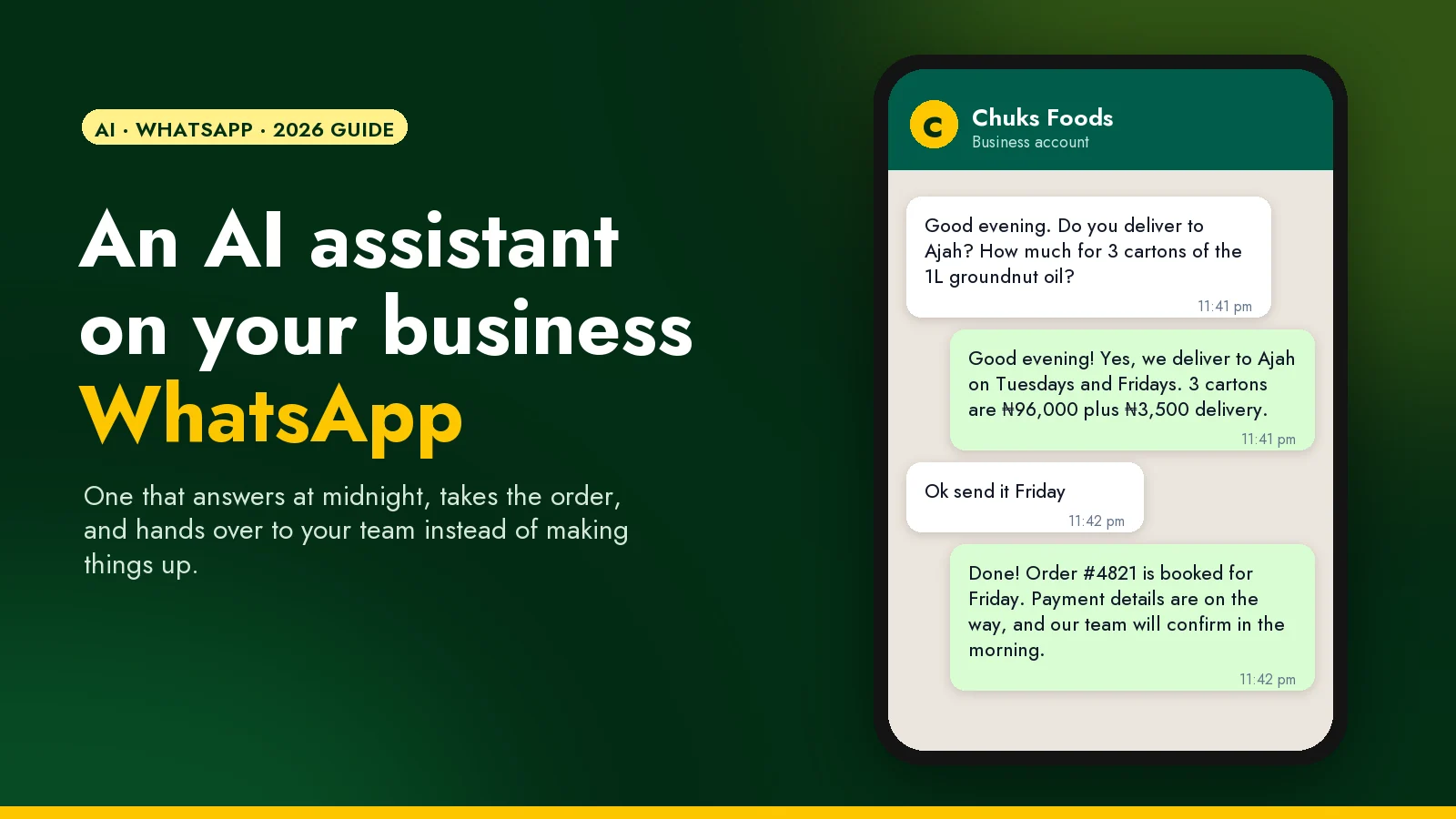
At 11:41 on a Thursday night, someone messages your business on WhatsApp: "Do you deliver to Ajah? How much for 3 cartons?" Your staff are asleep. By the time anyone replies at 8:30 the next morning, that customer has already bought from whoever answered first.
That gap is why so many businesses are looking at AI assistants for WhatsApp. Done well, an assistant answers that question in seconds, takes the order, and leaves your team a tidy summary for the morning. Done badly, it confidently quotes a price you stopped charging in March, or promises a delivery date nobody can meet.
This guide covers what an AI assistant on WhatsApp can realistically do for a Nigerian business, the rules Meta introduced in 2026, what it costs to run, and the part most guides skip: how to stop it making things up.
What an AI assistant on WhatsApp actually does
Forget the idea of a robot that "knows everything". A useful business assistant does a small number of things very reliably:
- Answers your common questions from your own information: prices, product details, delivery areas and days, opening hours, return policy. Look through your chats and you'll find most messages are some version of the same fifteen or twenty questions.
- Takes simple orders and bookings. It collects what's needed (item, quantity, address, preferred day), confirms the total, and creates the order or appointment in your system.
- Gives status updates. "Where is my order?" answered from your order records, not from guesswork.
- Hands over to a person for anything it can't handle well: complaints, refunds, negotiations, unusual requests. It passes the whole conversation along so the customer doesn't have to repeat themselves.
It should also cope with the way your customers actually write: short messages, voice-note habits, a mix of English and Pidgin, typos, and three questions in one message.
Meta's 2026 rules: what's allowed now
From 15 January 2026, Meta stopped allowing general-purpose AI chatbots on the WhatsApp Business Platform. These are services whose main product is the AI itself, such as ChatGPT-style "ask me anything" assistants. Meta was explicit that this doesn't affect businesses using AI to serve their own customers.
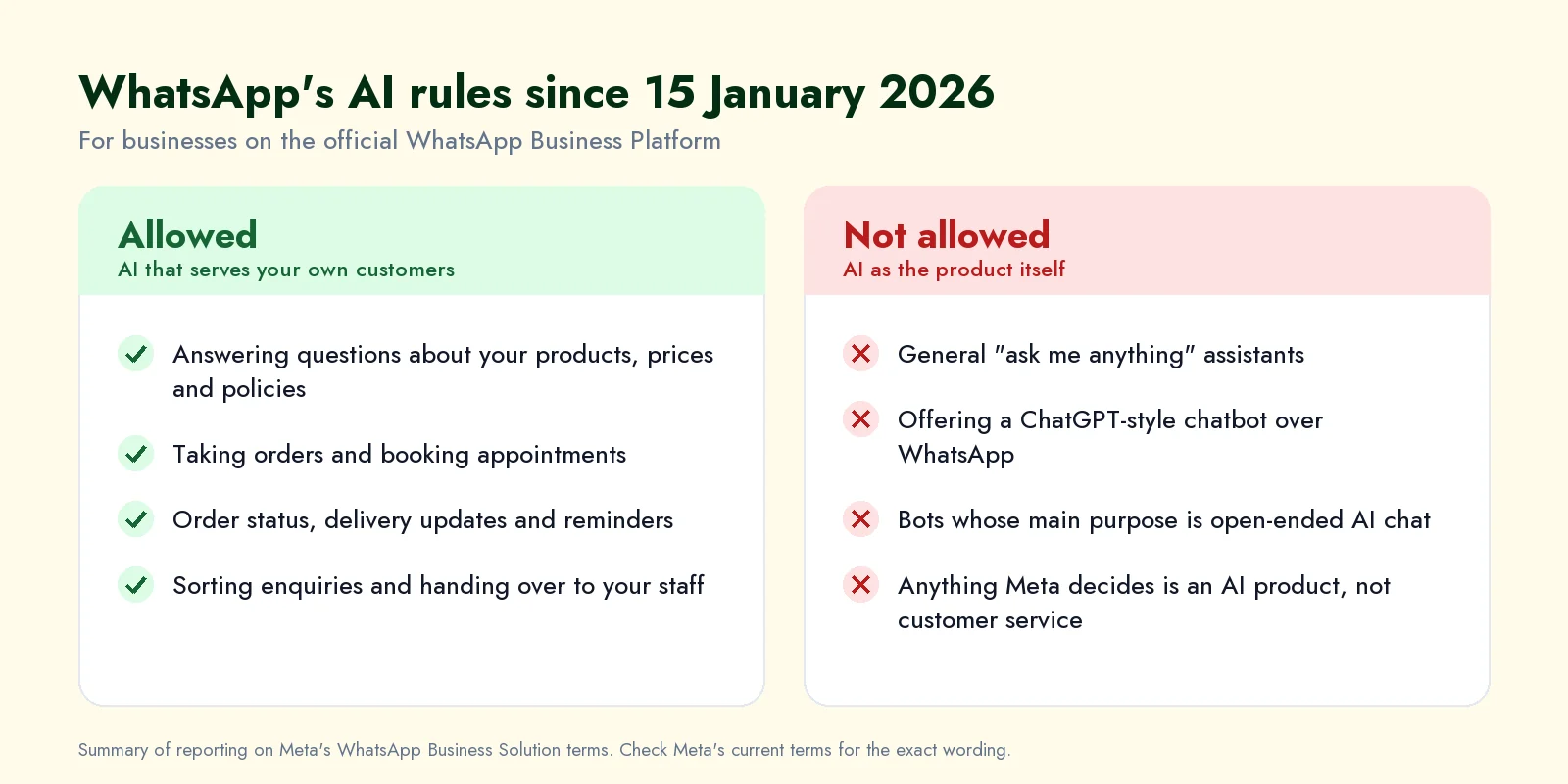
In practice, that means:
- An assistant for your own business is fine. Answering questions about your products, taking orders, booking appointments and sending updates are exactly the uses Meta says it still supports.
- Keep it on topic. If someone asks your bakery's assistant to write their CV or explain quantum physics, it should politely steer back to what it's there for. That's good customer service anyway, and it keeps you clearly on the right side of the rules.
- Meta decides where the line is. The terms leave it to Meta to judge what counts as an AI product rather than customer service. A focused assistant is the safe design.
You need the official WhatsApp Business Platform
There are three ways businesses put automation on WhatsApp, and only one is safe for an AI assistant:
- The WhatsApp Business app on a phone. It's free and has quick replies and away messages, but it isn't built for automated conversations.
- Unofficial tools that automate a normal WhatsApp account, often sold cheaply. They break WhatsApp's terms, and the number they're connected to can be banned, taking your customer chats with it.
- The official WhatsApp Business Platform (Cloud API), used through Meta directly or an approved provider. This is what an AI assistant should run on.
If you already use the Business app on your main number, you may not have to give it up. Meta's coexistence option lets a number stay on the Business app while also connecting to the Cloud API, so your staff keep chatting from the app and the assistant works alongside them. There are limits: recent chat history syncs over, but older media and group chats don't. It also depends on your provider supporting coexistence in Nigeria, so confirm before you plan around it.
What it costs to run
Since 1 July 2025, WhatsApp charges per message, by message type, and the important question is who started the conversation, and when:
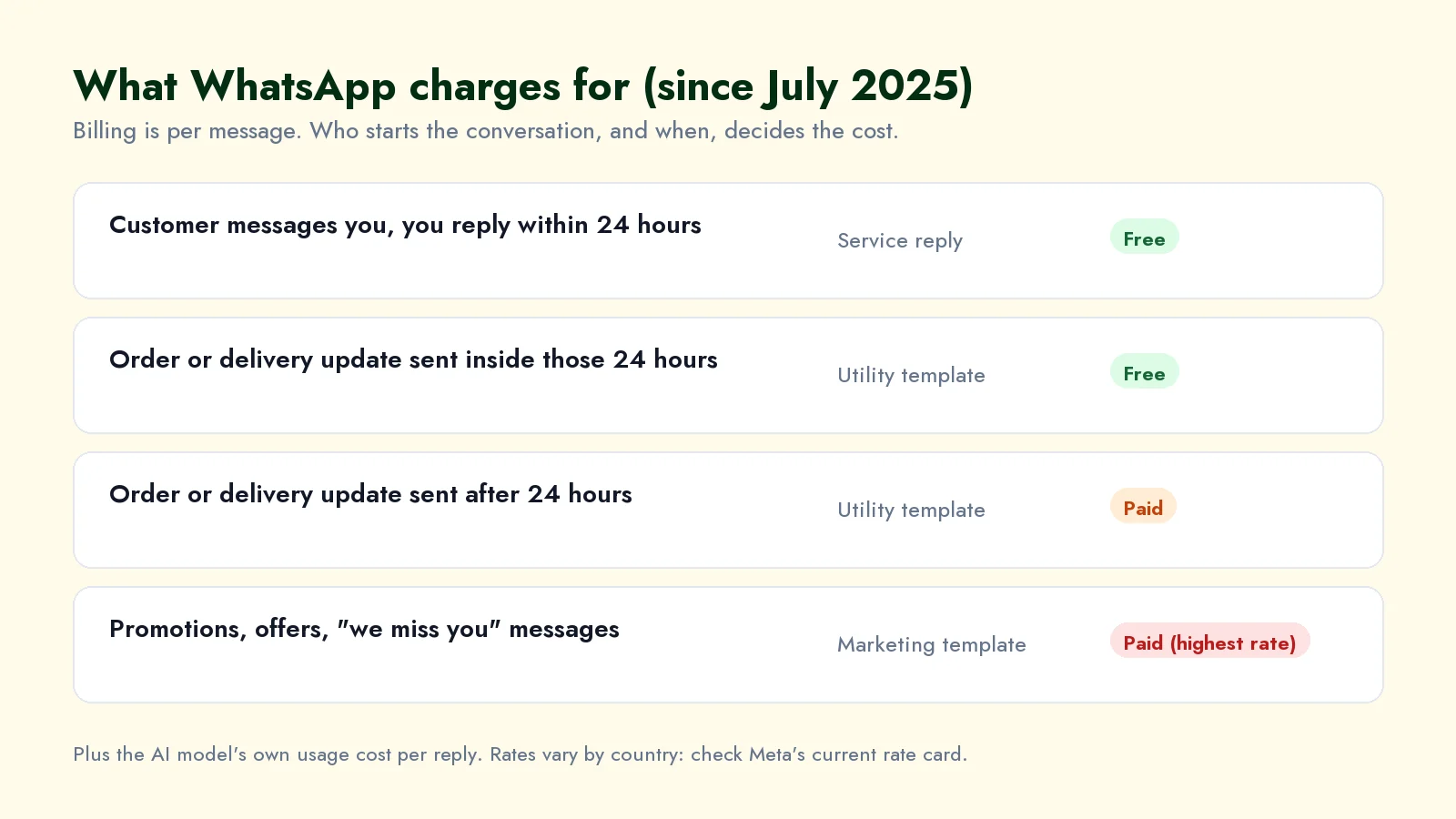
- When a customer messages you, a 24-hour window opens. Your replies inside that window are free, so an assistant answering questions costs nothing in WhatsApp fees.
- Order and delivery updates (Meta calls them utility templates) are free inside that window and paid outside it.
- Marketing messages (promotions, offers, "we haven't seen you in a while") are paid every time, at the highest rate.
Rates vary by country and change from time to time, so check Meta's current rate card for Nigeria rather than relying on a figure in any blog post, including this one.
On top of that, there are two other costs:
- The AI model's usage. Each reply the assistant writes costs a small amount from the AI provider, depending on the model and the length of the conversation. For a typical customer-service conversation it's modest, but budget for it in proportion to your message volume.
- Building and looking after it. That means the initial setup, connecting it to your price list and order system, and regular reviews to keep its information current.
The hard part: stopping it from making things up
AI language models are fluent, and fluency is the problem: a model with no information will still produce a confident, plausible answer. For a business, a wrong price or a promised delivery you can't keep is worse than no answer at all.
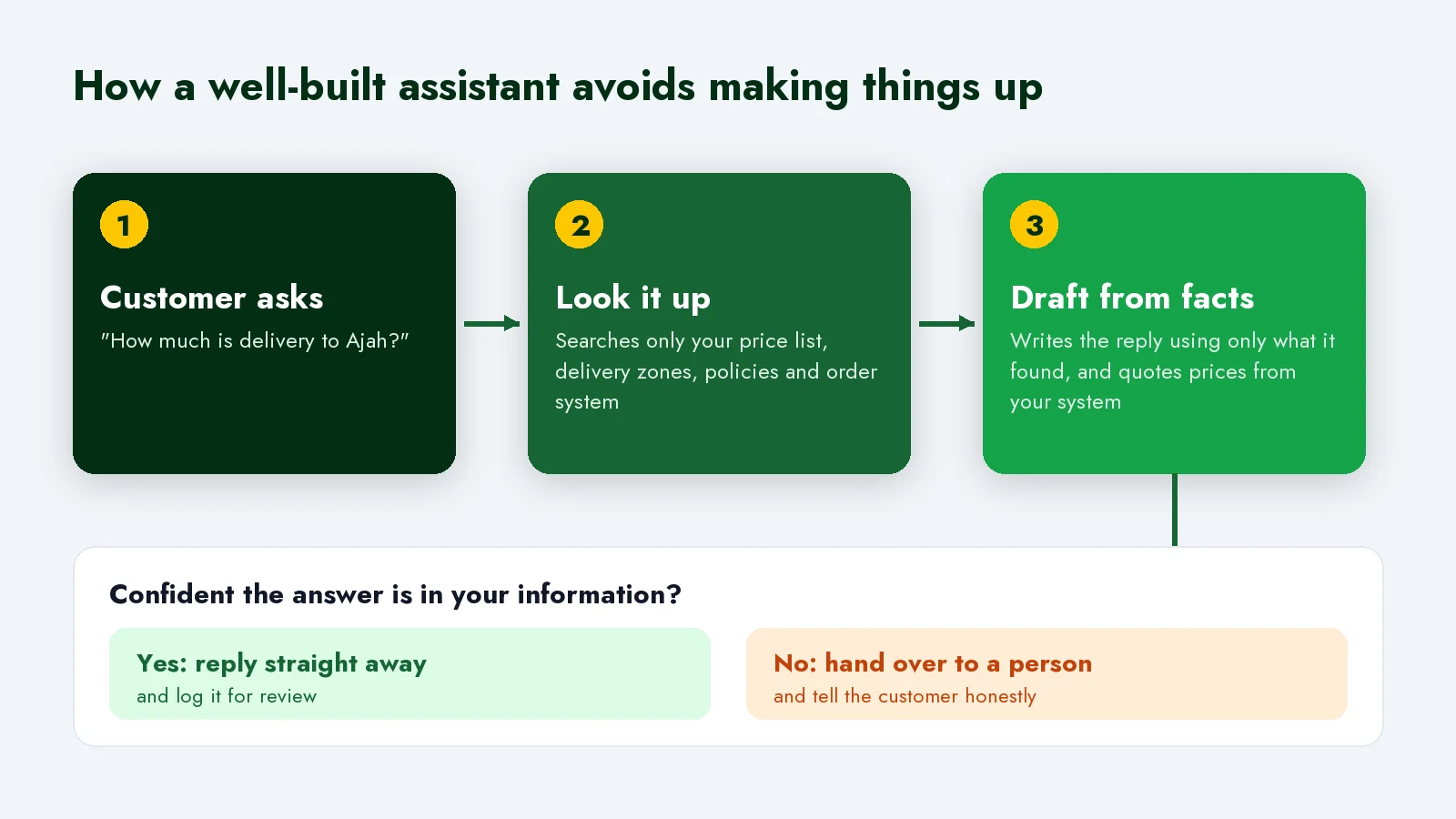
Here's how a well-built assistant stays honest:
- It answers from your information, not its memory. Before replying, it searches your price list, delivery zones, policies and FAQs, and writes the answer using only what it found. Developers call this retrieval-augmented generation. In plain terms, it's open-book, not closed-book.
- Prices and stock come straight from your system. Numbers that change should never be "remembered" by the AI. When a customer asks the price, the assistant looks it up at that moment, so updating your price list updates every answer.
- "I don't know" is a valid answer. If the answer isn't in your information, the assistant says so and hands over to a person, rather than guessing.
- Money and complaints always go to people. Refunds, disputes, unhappy customers, and anything about payments that doesn't match your records should be handed over automatically.
- It's tested on your real conversations. Before customers see it, it's checked against a sample of your actual past chats, including the messy ones, and fixed until it handles them properly.
- Every conversation is logged and reviewed. Questions it couldn't answer show you exactly what information to add next.
Designing the hand-over
The hand-over is where customers decide whether your assistant is helpful or infuriating. Get these right:
- Tell the customer what's happening. "I'll pass this to Bisi from our team. She's in from 8am and will reply here" is far better than going silent.
- Pass the whole conversation. The person taking over should see everything the customer said, so nobody has to repeat themselves.
- Notify the right person. Route sales questions to sales and complaints to whoever handles them, ideally with an alert outside office hours for anything urgent.
- Be upfront that it's an assistant. Customers are generally fine talking to an automated assistant as long as they know, and know they can reach a human.
Customer data and the law
Chats contain names, phone numbers, addresses and sometimes payment details, which makes them personal data under the Nigeria Data Protection Act 2023. Store conversations on systems you control, limit who can read them, don't send more personal information to the AI provider than each reply needs, and mention the assistant in your privacy policy.
A realistic way to roll it out
- Collect the real questions. Export a few weeks of your WhatsApp chats and list what people ask most often, in their own words.
- Gather your answers in one place. Prices, delivery rules, policies, opening hours. If your team disagrees about an answer, settle it now, because the assistant will repeat whatever it's given.
- Build and test privately. Run it against your real past conversations until the answers are right and the hand-overs happen when they should.
- Launch cautiously. Start with strict hand-over rules, so it passes anything uncertain to a person. Loosen them as the answers prove reliable.
- Review every week at first. Read the conversations it handed over or couldn't answer, and add the missing information.
When it's not worth it (yet)
If you get a handful of WhatsApp messages a day and someone answers them quickly, the Business app's quick replies and away message may be all you need. An AI assistant pays off when message volume is high, when questions repeat, when customers message outside working hours, or when slow replies are visibly costing you sales.
If you're thinking about an assistant for your business, tell us how customers reach you today or book a 30-minute call. We'll go through your real messages with you and give you an honest view of whether an assistant would pay for itself. You can also read more about our AI assistants and WhatsApp work.
Frequently asked questions
Did WhatsApp ban AI chatbots?
It banned general-purpose AI chatbots, where the AI is the product being offered, from the WhatsApp Business Platform from 15 January 2026. Businesses using AI to serve their own customers (answering questions, taking orders, sending updates) are still allowed.
Can I keep using my current WhatsApp number?
Often, yes. Meta's coexistence option lets a number on the WhatsApp Business app also connect to the official platform, so your staff can keep using the app. It depends on your provider supporting it, and some older chat media and group chats don't carry over.
Will it understand Pidgin?
Modern AI models handle Nigerian English and Pidgin reasonably well, but "reasonably" isn't good enough for customers. Test it against your real chats, including the informal ones, before launch.
What happens when it doesn't know the answer?
A well-built assistant tells the customer it's passing them to a person, hands over the full conversation, and alerts your team. It should never guess, especially about prices, delivery dates or payments.
How much does it cost?
There are three parts: WhatsApp's per-message fees (replies within 24 hours of a customer's message are free), the AI model's usage, and the cost of building and maintaining the assistant. Your message volume drives the first two, so start by measuring how many messages you get and what they're about.
Dealing with something like this in your business?
Talk to us